

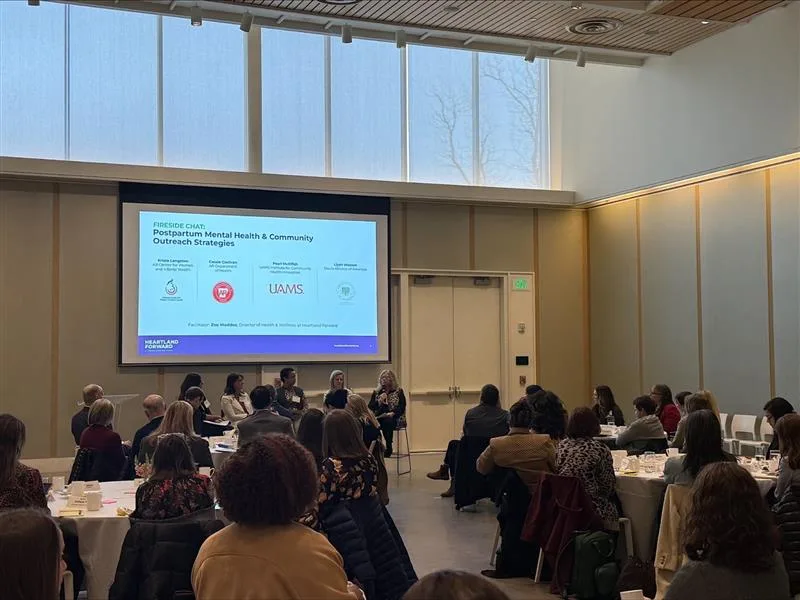
Arkansas maternal health stakeholders convened on December 4, 2025 in Bentonville, Arkansas, to reflect on their collective effort in helping shape and pass the Healthy Moms, Health Babies Act. The law and other coordinated legislation, which passed in February 2025, focused on improving maternal health in Arkansas through a supported workforce, new payment structures and telehealth initiatives. Having each played a role in advancing this legislation, stakeholders came back together this month to realign on legislative priorities and renew their maternal health working strategy.
Convener Heartland Forward hosted 80 of these maternal health stakeholders for a statewide meeting featuring spotlight sessions on postpartum mental health and Arkansas’ midwifery workforce, along with working group evaluations of the Act’s key provisions. Across the discussions, attendees reaffirmed a shared goal: the need to continue improving access to and delivery of maternal health care for every Arkansas mother.
The broad coalition of maternal stakeholders represented many organizations, including:
- Heartland Forward’s Maternal and Child Health Center for Policy and Practice (MCH CPP), a maternal health policy hub within the think-and-do tank dedicated to creating lasting and sustainable solutions to improve health outcomes for mothers and children in Arkansas and the broader heartland region.
- Hospital staff, including nurses, educators, administrators, executives and more.
- Maternal health providers, including midwives, Registered Nurses (RNs), Obstetrics and Gynecologists (OB/GYN) and more.
- Members of the Arkansas State Legislature.
- The Arkansas Department of Health.
- The Doula Alliance of Arkansas, a statewide membership organization working to improve maternal health by supporting and advancing the doula profession. Maternal health doulas are trained professionals who provide physical, behavioral and educational support to pregnant women and their families before, during and after birth.
- The University of Arkansas for Medical Sciences (UAMS).
Together, these stakeholders reviewed Arkansas’ maternal health landscape, shared experiences from clinical and community settings and surfaced three recurring priorities: the need to expand the maternal health workforce, create additional training opportunities while improving care coordination and delivering care to mothers and families where they live.
1. Expand and Strengthen the Maternal Health Workforce
Stakeholders emphasized improving outcomes requires investing in a maternal health care team—midwives, doulas, Community Health Workers (CHWs), OB/GYNs, lactation specialists—as each provider offers different types of care to prevent complications. The maternal health care team model supports mothers and families before, during and after pregnancy and reduces costly complications through preventive care.
Midwives, who are associated with fewer cesarean deliveries, preterm births, inductions and interventions, as well as higher patient satisfaction, play a key role in the maternal health care team, especially in rural communities. Yet, as of May 2024, Arkansas had only 49 certified midwives practicing in the state. The UAMS Master of Nursing Science Program in Nurse-Midwifery, now accepting applications for its inaugural Fall 2026 cohort, aims to expand this workforce, with additional attention towards workforce placement after graduation so Arkansas can retain its own midwifery talent.
As Dr. Samantha Crouch, the Director of the Nurse-Midwifery Program and Clinical Assistant Professor at the UAMS said: “When looking to decrease the cost [of maternal health care] while maintaining safe standards, midwives are well positioned to expand care while improving outcomes.” Growing the midwifery workforce, alongside other providers like doulas and CHWs, remains a promising way to increase access to maternal health care across Arkansas.
2. Commit to Continuous Up-Skilling and Continuity of Care
Stakeholders stressed expanding the workforce is only part of the solution; investing in the upskilling of the workforce while ensuring consistent and coordinated care requires professional development pathways and system-level integration for all providers.
The Doula Alliance of Arkansas is demonstrating what this commitment can look like, as Liyah Wasson, Executive Director & Co-Founder noted, “Professional development for doulas is constant and continuous, covering a spectrum of development and the Doula Alliance of Arkansas is a resource for community-based doulas to constantly be upskilled. Moving forward we plan to offer continuous education for postpartum mental health, for trauma services and for a wide range of needs that exist in the communities for doulas, who are welcomed into homes as parts of families.”
Training alone is not enough—true continuity of care requires integrated systems, meaning doulas, CHWs, midwives, behavioral health professionals and OB/GYNs can communicate and coordinate care on shared digital platforms. A patient’s care team should not operate in silos and a seamless transition between providers can be a difference maker for getting necessary care. By strengthening data-sharing, promoting closed-loop referral systems and implementing interoperability—when different systems can operate together—Arkansas can support a maternal health workforce that is both skilled and connected.
3. Bring Care to Where Patients Are Through Community Access Points
A recurring theme throughout the meeting was the importance of providing care to patients where they are located, transportation barriers and limited provider availability shape maternal health outcomes in Arkansas, particularly in rural regions.
“Having a provider alongside the patient, in the patient’s home, where the patient is, is the best way to support all moms across Arkansas,” said Pearl McElfish, Associate Provost and founding Director of the Institute for Community Health Innovation at the UAMS. “We need to be committed to understanding where patients spend time in their everyday lives and show up to where they are.”
Speakers highlighted successful models reaching mothers where they live, like the Arkansas Center for Women and Infants’ Health Proactive Postpartum Call Center, a telehealth model bridging distance and earning high patient satisfaction by proactively reaching out to all postpartum mothers for care coordination, screening and support. Additionally, CHWs, doulas and midwives play crucial roles in extending care into homes and communities, reinforcing clinical care plans through community-based resources.
Looking Forward: Arkansas’ Collaboration on Maternal Health Care
This meeting demonstrated strong momentum from Arkansas’ maternal health care stakeholders, sharing a clear vision for the work ahead:
- Expand the maternal health care workforce and advocate for the team approach
- Strengthen professional development and continuity of care
- Deliver care from within the community, to the community
These priorities support healthier mothers and babies, as well as strengthen family stability, workforce participation and economic well-being across the state. With continued collaboration and coordination, Arkansas’s maternal health community is taking critical steps toward a more effective future.
The Maternal and Child Health Center for Policy and Practice will continue to host these convenings on a quarterly basis to serve as a recurring forum for implementation progress and policy improvements. This work is generously supported by the Center’s founding funders: the Blue & You Foundation for a Healthier Arkansas, the Centene Foundation, the Walton Family Foundation and Walmart.