

Rural America is poised for a moment of significant economic opportunity. From advanced manufacturing to energy and infrastructure, new investments are reshaping where jobs are located—and increasingly, they are landing within reach of rural communities. Nearly two-thirds of the $1 trillion in announced advanced manufacturing investments are expected to be located within commuting distance of rural areas across America, bringing the potential for billions in new wages.
Seizing this opportunity will depend on whether rural communities—particularly rural students—are prepared to fully capitalize on it.
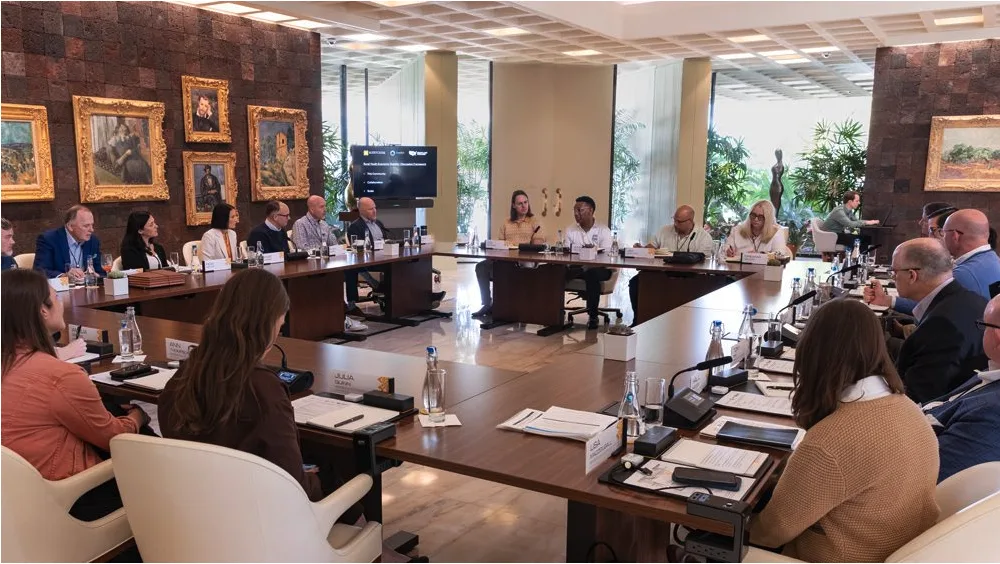
At Sunnylands in early February, Heartland Forward and rootEd Alliance partnered to host “Deep Roots, Strong Futures: Advancing Rural Youth Economic Mobility.” The convening brought together policymakers, business leaders, educators and philanthropists to explore how to increase economic mobility for rural youth and build a workforce ready for the jobs of tomorrow. rootEd Alliance is a national non-profit operating in seven states that places dedicated career advisors in rural high schools to support students in defining and realizing their career goals — whether through a college degree, workforce credentials, apprenticeship, or military service — while partnering with communities, states, and employers to close talent gaps and drive rural economic prosperity.
The stakes extend well beyond rural communities. Rural students make up nearly one in five young people in the United States, representing a meaningful share of the country’s future workforce. Yet too often, the systems designed to prepare them for careers are misaligned with rapidly evolving labor market demand or fall short of preparing students to succeed after high school. Postsecondary attainment continues to lag behind urban areas, and businesses in rural areas tend to have more difficulty finding workers than businesses in large urban centers. What has long been treated as a regional issue is, in reality, a national workforce challenge with implications for long-term economic growth and competitiveness.
Conversations at Sunnylands spotlighted approaches to ready the rural workforce that are effective. Across the country, emerging models are demonstrating how stronger alignment between education, employers and community institutions can create clearer pathways to opportunity. In such models, students gain exposure to careers earlier, employers shape training pathways and success is measured not just by degrees earned, but by jobs secured and wages gained.
One example is rootEd Arkansas, which provided dedicated college and career advising to rural high school students in 13 high schools in the 2025-2026 academic year. After just one year of the program, 12.9% more students are pursuing college and career training after high school and non-college-bound students estimated earnings over $11,000 higher than similar students before the rootEd program. rootEd’s model, recently highlighted by the Wall Street Journal, illustrates how targeted one-on-one support, combined with intentional employer engagement, can translate into stronger employment outcomes and long-term economic mobility.
Experiences like this point to a broader conclusion from the convening: many of the necessary solutions already exist. The challenge is not just identifying what works, but expanding these programs to reach more students and communities.
Participants identified a consistent set of barriers limiting expansion, including fragmented alignment efforts, short-term or locally misaligned funding for effective programs, and education systems that prioritize enrollment and degree attainment over employment outcomes. Without greater coordination, even impactful programs struggle to scale impact. With that in mind, the discussions at Sunnylands helped shape three key priorities to address these challenges and accelerate progress:
- Establish a Rural Youth Economic Mobility Coalition: A more coordinated national approach is needed to reduce fragmentation and sustain momentum. A dedicated coalition would provide a central platform for cross-sector leaders to align, share best practices, advance research and develop policy recommendations. Over time, it could also support place-based experimentation and help replicate effective local models across regions.
- Scale Working Solutions: Many high-impact programs are already delivering results, but too few have the resources to expand. Increasing the flow of public and private capital to rural communities—while prioritizing the replication and adaptation of proven models—would allow more communities to benefit. Stronger employer engagement will be essential to ensure these efforts remain aligned with evolving labor market demand.
- Identify and Scale Best-in-Class Policy: Policy frameworks at the federal, state and local levels must better reflect the realities of today’s economy. Prioritizing measurable employment outcomes, including job placement and wage growth, can help realign incentives across education and workforce systems. Elevating and embedding best-in-class policies in funding structures and accountability systems will be key to sustaining long-term progress.
Taking action in these ways must first involve building alignment among policymakers, funders and practitioners so proven models can expand and succeed in new communities. Continuing to convene leaders across sectors is critical, as it creates space for shared priorities to emerge and for a more unified national approach to take shape.
The broader picture is clear. Rural regions are well-positioned to benefit from major economic tailwinds, from reshoring to the energy transition. But those gains will only be realized if the workforce is ready. Preparing rural students for these opportunities is not only vital to their success; it is essential for the long-term competitiveness of rural communities and the strength of the national economy.
Read the full action plan here: Deep Roots, Strong Futures: Advancing Rural Youth Economic Mobility
Learn more about Heartland Forward’s work building the talent pipeline:
- rootEd Arkansas: A public-private partnership between Heartland Forward, rootEd Alliance and the Arkansas Department of Education, provides one-on-one support to ensure rural students graduate prepared for career success and economic stability.
- Skilled Trades Initiative: Heartland Forward, in partnership with the BlackRock Foundation, is working to expand career pathways and strengthen the talent pipeline across the heartland.
- Connecting the Heartland: Heartland Forward supports the high-speed internet workforce through the Connecting the Heartland Jobs Board, which features more than 700 ISP jobs and 250 training programs across Arkansas, Illinois, Louisiana, Ohio, Oklahoma and Tennessee—connecting workers at all career stages with training providers and employers.