

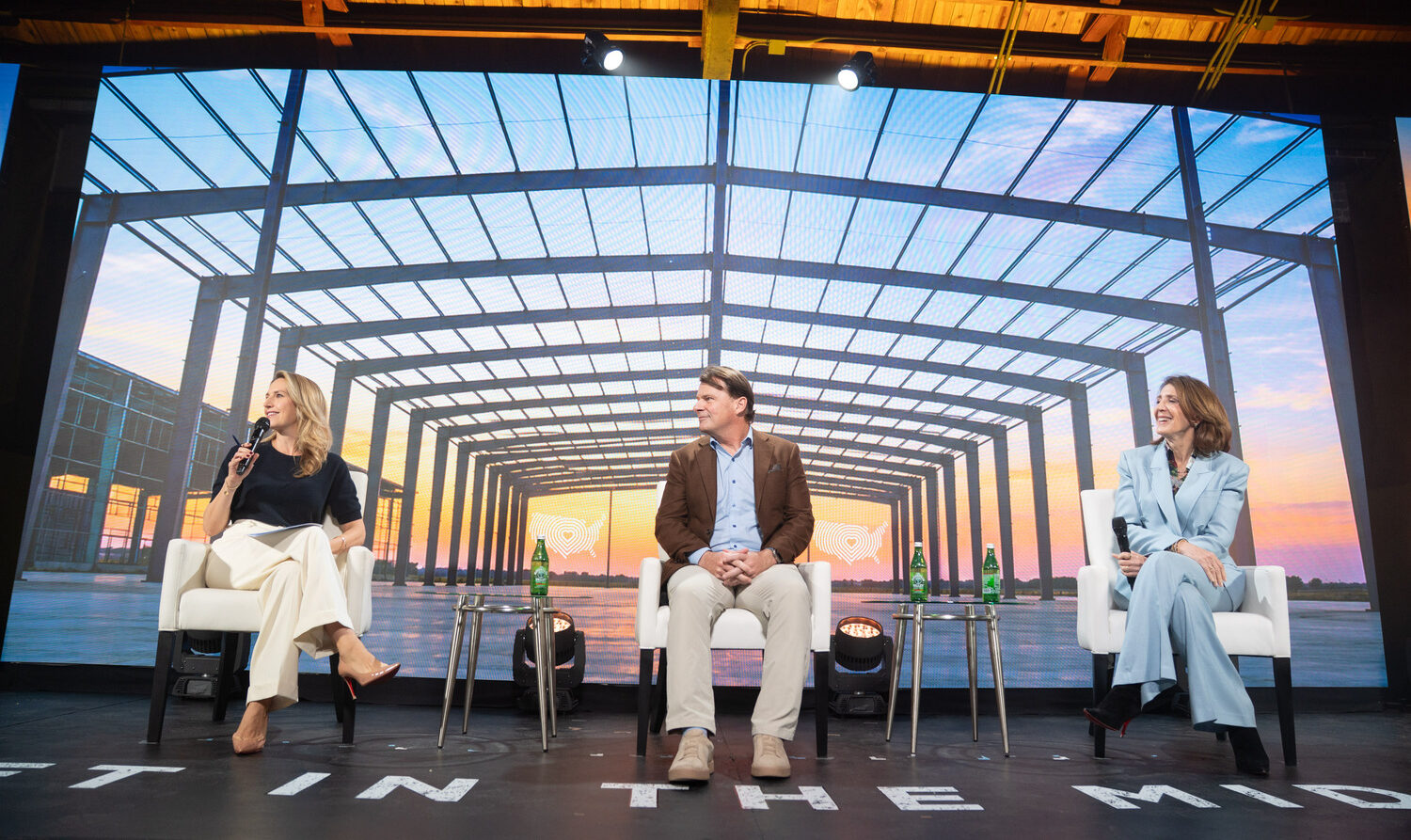
Heartland Summit in Bentonville, Arkansas Thursday, October 1, 2026. (© 2026 Michael Connor / Connor Studios)
This fall, approximately 350 leaders gathered in downtown Bentonville, Arkansas, to “Meet in the Middle” at the 2026 Heartland Summit, Heartland Forward’s flagship event. Over two days, policymakers, investors, entrepreneurs and business, philanthropy and thought leaders discussed the challenges and opportunities facing the middle of the country.
The skilled workforce was a central topic in many of those discussions. Data centers, power grids, advanced manufacturing and infrastructure all depend on electricians, welders, mechanics and technicians, and employers across industries face a growing shortage of qualified workers, which the U.S. Department of Education estimates could cost the U.S. economy as much as $1 trillion annually. To help address this gap, Heartland Forward announced a new partnership with The BlackRock Foundation to connect more students to skilled careers close to home.
Among the leading voices on this issue is Jim Farley, president and CEO of Ford Motor Company. Farley has been outspoken about the labor shortages and productivity challenges facing what he calls America’s Essential Economy—the construction, manufacturing, energy, public services, transportation,logistics and skilled trades industries that employ 95 million workers across 3 million businesses, driving more than a third of U.S. GDP. Ford’s perspective is rooted in more than a century of building vehicles alongside skilled workers and the technicians who service them.
At the Summit, Farley joined Ruth Porat, president and chief investment officer of Alphabet and Google, for a panel titled “Skilled Trades: The Engine Powering Our Future Economy,” moderated by Poppy Harlow, founder and CEO of Day 2 Media. The conversation explored how the shortage of skilled workers affects economic growth in the heartland and how leaders from across tech, finance and manufacturing are working together to expand the skilled workforce. After the session, Farley sat down with Pulse of the Heartland for a brief conversation.
This interview has been edited for length and clarity.
Ford recently joined BlackRock, Google and Carhartt to form the Alliance for America’s Skilled Trades, and Heartland Forward has announced its own skilled trades partnership with The BlackRock Foundation. Why are so many leading organizations drawn to supporting this part of the workforce right now?
The reason so many unusual bedfellows are coming together around the skilled trades is very simple. We have a 2 million-person gap in the skilled trades in our country, and every single company in America is suffering. If you’re in the auto business, there aren’t enough mechanics to work on the cars. If you want to build a home, or you’re rebuilding after a hurricane in North Carolina, there aren’t enough carpenters. It’s a crisis across our country.
The real root cause is education. We have to show people the value of these jobs and how wonderful they can be. And we have to get after it as a group, because no single initiative is working on its own.
What does a convening like the Heartland Summit offer a company like Ford, and why is it important for you to be here?
This opportunity is important for Ford because we can handle our own skilled trades needs as a company. We have a lot of resources. So many of our jobs are $100,000-plus jobs. We have great jobs and great careers, and we’ve been doing this for more than 120 years.
But Ford recognizes that companies like ours need values that stand for something bigger than ourselves. We saw that during World War II, when Ford was part of the Arsenal of Democracy, and again during COVID. This issue is so important to the vibrancy and sustainability of our country. Ford wants to come here and spread the word. We want to get more people committed, even individual parents, to being open-minded about alternatives to a four-year degree.
On a lighter note, what is your favorite car?
That’s a tough question for a car person. It really depends on the circumstances. Are you driving to a party? Going racing? If I had to pick, probably a 427 Cobra or a GT40.
But I think Carroll Shelby answered this question best. Someone once asked him, “Shelby, you’ve created all these great cars. What’s your favorite one?” He said, “The next one.” I think that’s the right answer.