

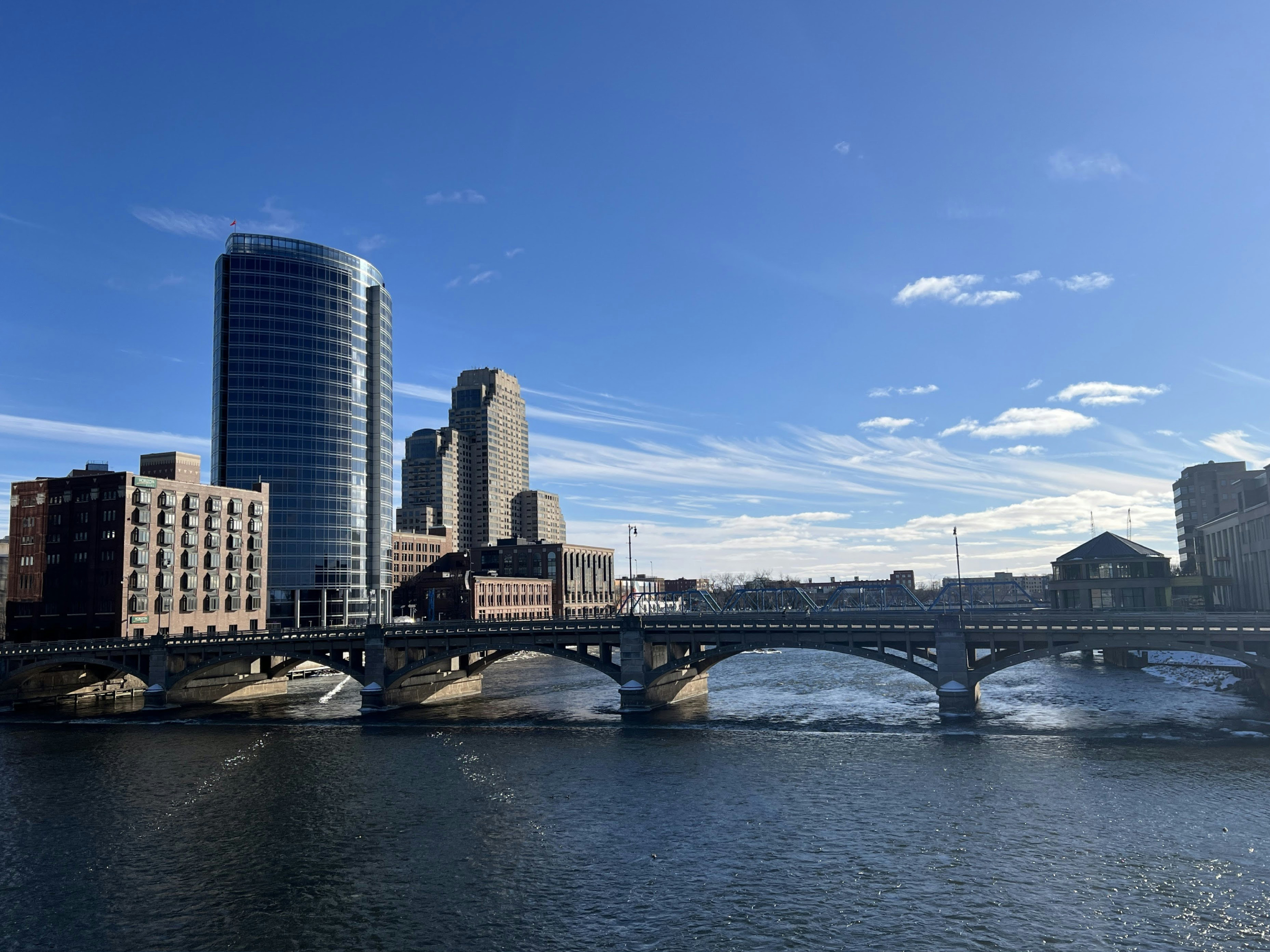
Every year at the Heartland Summit, Heartland Forward names three “Secret Sauce” communities—heartland towns and cities whose unique ingredients, a blend of assets, values and strategy have positioned them to compete and win in the global economy. Since the program launched at the inaugural Heartland Summit in 2018, eleven heartland communities have filled twelve Secret Sauce spots (Chattanooga, Tennessee, is the only city to be recognized twice), representing eleven heartland states and a growing playbook for economic success across the region.
This year, at the 2026 Heartland Summit, Heartland Forward recognized three new Secret Sauce communities: Oklahoma City, Oklahoma; Grand Rapids, Michigan; and Huntsville, Alabama. Each city arrives with its own secret sauce for success: a civic culture built on consensus, philanthropic investments punching above their weight and a legacy industry reinvented. What’s exciting is that all three share similar ingredients—sustained, intentional investment in their strengths, entrepreneurial opportunities and a vision for their region’s future.
Oklahoma City, Oklahoma: The Power of Consensus
Few cities have transformed as visibly or deliberately in the past few decades as Oklahoma City. Since 1993, Oklahoma City voters have approved 15 consecutive tax initiatives for development, funneling roughly $10 billion in self-imposed investment into the city’s infrastructure, quality of life and civic identity without a single measure failing at the ballot box.
“We’ve had 15 tax initiatives in Oklahoma City to build things,” said Mayor David Holt. “We’re 15 and zero… I haven’t had any [initiatives] get less than two-thirds support in my eight years as mayor.” Holt points to that track record as the foundation of the city’s growth: “If you drop $10 billion in a mid-sized American city, you’re going to see the rapid rise that we’ve seen here in OKC.”
That growth shows up in the numbers. Oklahoma City has climbed from the 37th-largest U.S. city to the 21st-largest in the last 50 years, powered in part by a diversified economy anchored by Tinker Air Force Base, a 44,500-worker aerospace sector and booming growth in bioscience, energy and logistics.
But Holt traces the deeper driver back to political culture rather than any single sector: “Our ability to work together… directly leads to our ability to invest in ourselves,” he said, describing a partnership between City Hall and the business community that makes the metropolitan area development initiatives possible. “That ability to work together, that unity, that consensus building that we seem so good at has allowed us to pass all these initiatives, which has allowed us to invest in our city to an unbelievable degree.”
That same collaborative instinct extends to how the city has built its identity from its 2025 NBA champion team, the Thunder, to the world’s premier softball stadium and a paddle-sports facility now set to host the 2028 Olympics’ canoe slalom and softball events. “Sports have meant so much to our city’s identity and brand,” Holt said. “It’s an easy way to get your name out there.”
Asked to name Oklahoma City’s Secret Sauce directly, Holt didn’t hesitate: “We put aside the things that divide us. We work together, we move through consensus… and that commitment to work together to get things done and invest in our city has ultimately been our secret sauce.”
Grand Rapids, Michigan: Philanthropy as Infrastructure
Grand Rapids built its identity as “America’s Furniture Capital” in the 1880s and has reinvented itself more than once since—as a brewing and manufacturing hub, and more recently as a center for health sciences and biomedical research anchored by the Medical Mile and Corewell Health, the region’s largest employer. What ties those chapters together, according to Mayor David LaGrand and Van Andel Institute Chairman and CEO David Van Andel, is a city that has deliberately avoided depending on any single industry.
“One of Grand Rapids’ real strengths is it’s not a monoculture,” LaGrand said. He points to the city’s continued ties to manufacturing, auto and pharmaceuticals alongside its newer health care and tech sectors as deliberate insurance against exactly that kind of shock.
That instinct toward reinvention runs alongside a second, distinctly Grand Rapids trait: a civic culture where private capital and public partnership move in lockstep. David Van Andel, whose family founded the biomedical research-focused Van Andel Institute, described the model plainly: “The secret sauce is public-private partnership…a lot of entrepreneurial spirit, hard work and industry—recognizing what’s important for a region and working with the public sector to build out the infrastructure and create opportunities.”
That instinct for collaboration and partnership isn’t confined to the boardroom, either. “This town is full of people who think, if there’s a challenge or a thing that has to [be] dealt with…[people] think, how are we all going to do that,” LaGrand said, highlighting a sense of civic ownership he sees as foundational to the city’s health.
That same instinct shows up again when the Van Andels and Mayor LaGrand talk about what comes next—less about what’s already been built, more about who carries it forward. “I think the biggest thing that excites me is getting this into another generation,” David Van Andel said. “We have to do our part of being able to train and mentor them…so that they can carry it forward.” The mayor put a similar idea in civic terms: “Retention is more important than attraction,” he said. “Attraction is the next shiny object, but valuing the companies and the people you already have is what helps you attract in the first place.”
When asked directly what makes Grand Rapids special, Mayor LaGrand landed on the same phrase as the Van Andels, just from a different angle: “In my opinion, the secret sauce is that Grand Rapids is filled with people who go out of their way to take care of each other, and who don’t want credit for the good work they’re doing.”
Huntsville, Alabama: Engineering a Culture of Collaboration
Known as “Rocket City” for its foundational role in the U.S. space program, Huntsville has become one of the fastest-growing cities in the country with its population reaching 249,102 in July 2025, a 15.9% increase since the 2020 Census. “If you don’t grow, you die,” said Mayor Tommy Battle, now in his fifth term. But growth alone doesn’t explain Huntsville’s rise. According to Chip Cherry, President and CEO of the Huntsville/Madison County Chamber of Commerce, the city’s real Secret Sauce isn’t any single industry, it’s a habit of mind.
“It’s the partnerships and collaborations that make things happen,” Cherry said, tracing the city’s culture back to its rapid transformation from an agrarian community to “the tip of the spear on the space race in a very short amount of time.” That history, he argued, shaped a distinctive mindset: “One of the real secrets to us is that [we don’t] start with ‘we can’t do it because of X, Y and Z.’ It starts with, we can do it this way…It starts with the art of the possible.”
Mayor Battle put that same instinct in more practical terms as a willingness to build relationships across every layer of government, regardless of who’s in power. “It’s all about collaboration, and collaboration is just about making new friends,” he said, describing the city’s successful collaboration with county, state and federal government entities, including the more than 70 federal tenant agencies stationed at Redstone Arsenal. “We work with everybody.”
That collaborative instinct has also shaped how Huntsville diversified its economy. When Battle took office in 2008, roughly 70% of the city’s jobs sat within the federal government’s orbit; today that figure is closer to 43%. “Diversification is huge for us,” Battle said, pointing to a deliberate push into advanced manufacturing that added roughly 35,000 jobs to the region and filled what he calls the “middle gap” between entry-level and highly specialized work. That same instinct carried the city into biotech. The HudsonAlpha Institute for Biotechnology, now the second-largest research facility of its kind in the U.S., helped Huntsville land a $6 billion investment from Eli Lilly.
Diversifying the economy meant diversifying the city’s reputation, too. A decade ago, Battle’s team commissioned what became known as a “music audit,” studying what had turned cities like Nashville and Austin into cultural destinations. The result was the Orion Amphitheater, the Mars Music Hall, and a live-music scene that landed the city on the cover of Billboard Magazine. Cherry sees that same investment in “quality of place” as central to how Huntsville competes for talent today: “[There] used to be a time when people would move for a job,” he said. “Now they move to find a community, and then find a job based on the community they love.”
That strategy, paired with a culture of shared credit and consistent long-term planning, has helped Huntsville post the strongest in-migration of new residents in the state. When asked about what makes Huntsville so unique, Cherry answered: “Teamwork…We don’t let egos get in the way. We sit down and figure out what we [can] do to move the community forward.”
A Growing Playbook
Oklahoma City’s consensus-driven civic culture, Grand Rapids’ philanthropic infrastructure and Huntsville’s engineering-rooted collaboration and teamwork are three very different strategies for success, but each reflects the same core lesson Heartland Forward has drawn from five award years of Secret Sauce communities. Economic transformation in the heartland rarely comes from a single industry or leader. It comes from real engagement between public, private and civic institutions that choose, again and again, to invest in their strengths, mobilize and support their communities and do so with an eye toward long-term sustainability and growth.