

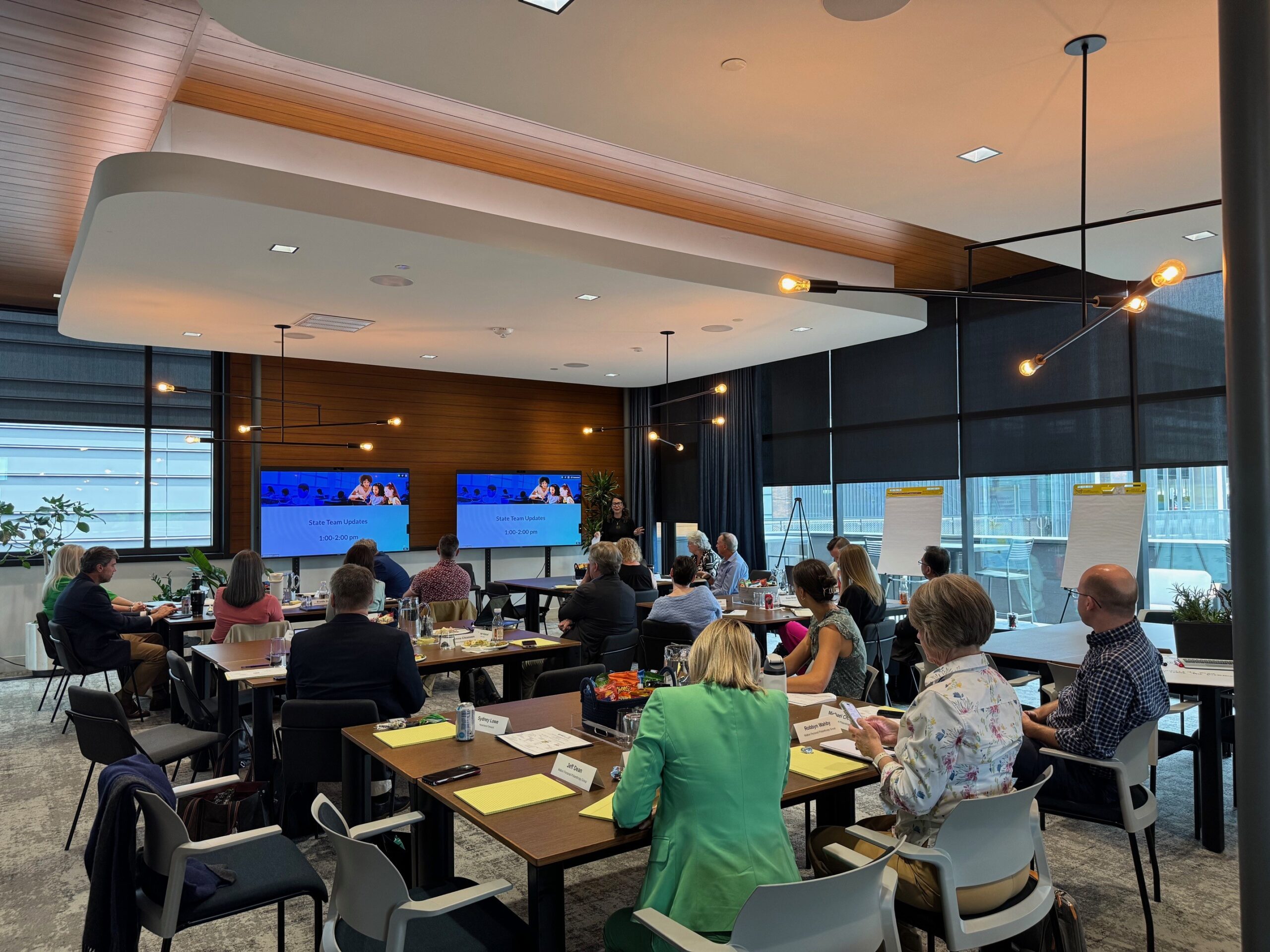
Heartland Educator Workforce Community of Practice Convening in Bentonville, Arkansas - July 2026
Teacher quality is one of the most important in-school factors for student achievement. Yet, across the heartland, Education Preparation Programs (EPPs), or teacher training programs, are not keeping pace with school districts’ demand. As districts work to fill teacher vacancies, some states have responded by loosening certification requirements, allowing a growing number of teachers to enter the classroom through alternative or emergency pathways. The result is a growing disconnect between what students need—a well-prepared, well-supported teacher in every classroom—and what educator pipelines are currently able to deliver.
To address the gap and strengthen teacher pipelines across the heartland, Heartland Forward partnered with the Walton Personal Philanthropy Group and Education First, a national mission-driven education consultancy partnering with system leaders, to launch the Heartland Educator Workforce Community of Practice. The Community of Practice is a cross-state collaborative bringing together state education leaders from Arkansas, Missouri and Oklahoma to address shared challenges, improve data systems and align on best practices to strengthen the educator workforce pipeline throughout the region.
Through bi-weekly state coaching calls, state-specific action planning, discussions with national and state experts and two in-person, cross-state convenings, the Community of Practice provided state leaders with a strong peer network and access to technical policy support and guidance. These touchpoints created space for leaders to evaluate strategies for attracting, preparing, developing and retaining high-quality teachers, and to develop their own state-specific plans of action.

While each state brought a distinct perspective and set of questions, all three entered into the Community of Practice with a shared belief that accelerating student achievement requires a strong, well-prepared educator workforce. Across the three states, this work centered on strengthening the data systems that track three critical areas of the educator pipeline—training, mentoring and retention—to better inform policy and decision-making. With an underlying commitment to placing effective teachers in classrooms throughout the region, leaders from Arkansas, Missouri and Oklahoma translated the year’s collaboration into concrete, measurable action.
Over the course of the year, state leaders worked to address three key areas:
- Ensuring all new teachers are well-trained and prepared to be effective: At the beginning of the 2025-2026 school year, more than half (54%) of first-year teachers in one state entered the classroom without a standard certificate, before undergoing a full preparation experience. To better train teachers, and ultimately help keep them in classrooms for longer, state leaders evaluated preparation programs and built clear frameworks and guardrails for teacher certifications to ensure that all classrooms are led by teachers who are fully equipped to succeed.
- Ensuring all new teachers are well-supported through high quality mentorship and onboarding during their early years in the profession: Facing a growing gap between districts’ demand and certified first-year teachers, one state focused its efforts on strengthening teacher retention. Aiming to build on the state’s increase in teacher retention over the past three years while neighboring states saw declines, leaders concentrated on expanding access to high-quality mentoring programs—particularly in rural and under-resourced communities—so that new teachers receive strong, structured support to help them grow and stay in the classroom.
- Assessing why effective teachers leave: In one state, teacher retention rates varied widely across districts, ranging from 55% to 95%. State leaders sought to better understand and track this variation, examining the factors contributing to teacher drop-off across the career pipeline. To do so, they revised state surveys and data infrastructure to better capture teacher sentiment throughout their career journey—from entry into the profession to exit—and used those insights to strengthen the policies and supports that sustain teachers at each stage of their career.
To further support this work, Heartland Forward, Walton Personal Philanthropy Group and Education First convened the full Community of Practice in Bentonville twice throughout the year, providing the opportunity for cross-state learning and in-person connection between state leaders. The convening in February of 2026 focused primarily on assessing current data systems and establishing state-specific goals and plans of action, while conversations in July showcased the culmination of a year’s worth of effort and investment—specifically, the identification of shared research questions focused on strengthening the teacher pipeline and improving teacher preparation, effectiveness and retention.
These events provided state leaders with both a forum to discuss shared problems and the opportunity to develop collaborative solutions. As one participant shared, “I appreciate the work that other states are doing that parallels our own. It is always encouraging to hear how they are approaching the same challenges.”
The Heartland Educator Workforce Community of Practice was built around a central goal: advancing solutions that help ensure every teacher entering the classroom is well-prepared and well-supported to have a positive impact on student learning. Even as each state addressed its own distinct challenges, this cross-state framework gave leaders a way to learn from one another and turn collaboration into action. The first year offers a replicable model for strengthening teacher workforce pipelines across the country and proof that when leaders develop research-backed, data-informed strategies and have the opportunity to convene and share best practices, real progress can be made on even the most persistent challenges in education.
Learn More
- Building the Talent Pipeline: Heartland Forward’s Talent Pipeline impact area gives communities the data and tools to build talent through education, entrepreneurship and workforce development.
- Supporting Rural Students: rootEd Arkansas, a partnership between Heartland Forward, rootEd Alliance and the Arkansas Department of Education, places college and career advisers in rural high schools across the state.
- Tracking Education Policy: Heartland Policy Update: Talent Pipeline Legislation in 2026 reviews the education and workforce bills heartland legislatures are taking up this year.