


How Clinically Integrated Networks (CINs) Can Support Heartland Health Care Access
Across the heartland, many communities access health care through smaller medical practices or local doctors offices. These providers are often not part of a larger health or hospital system, which means they face the burdens of contemporary health care delivery on their own, including rising technology costs, workforce shortages and bureaucratic requirements. While some providers develop informal partnerships to coordinate care, these arrangements can lack the shared infrastructure and governance needed to support long-term collaboration. A new approach to care delivery—known as a Clinically Integrated Network (CIN)—is emerging as a way to sustain independent providers through formal collaboration, in regions where they are needed most.
Defining a Clinically Integrated Network
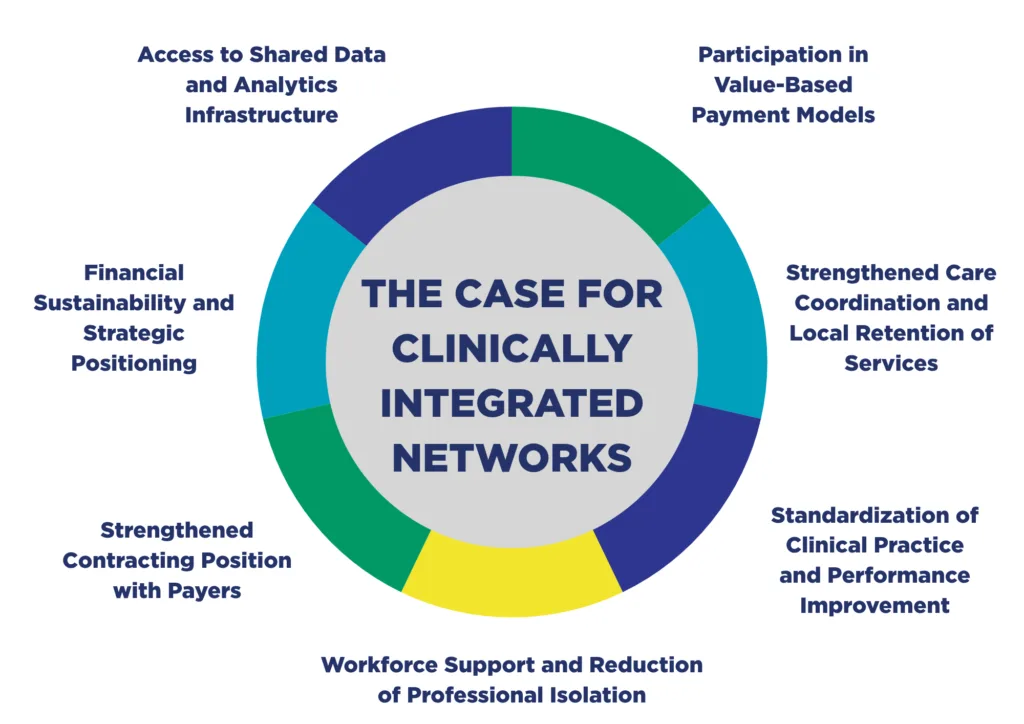
A CIN is a group of independent health care providers—ranging from primary care physicians and advanced practice providers, such as certified nurse midwives, to behavioral health specialists, pediatricians and obstetrician gynecologists—who formally collaborate on health care delivery to ensure comprehensive care for patients. Much like larger health or hospital systems, CINs share clinical practices, patient information, performance metrics and data infrastructure to ensure that information is not siloed and patients get the thorough care they need across providers. At their core, CINs improve patient care, help smaller providers enhance their operational procedures and offer opportunities for innovative solutions, allowing providers to focus on the best outcomes for patients.
How to Create a Clinically Integrated Network
While there is not a single regulatory or universal blueprint for establishing a CIN, successful CINs consistently share a common set of foundational capabilities. Participating providers often agree to adopt shared clinical protocols, track outcome measures, access patient records across providers and share data infrastructure, as well as formalize governance mechanisms and participation expectations.
When standing up a CIN, providers often convene either according to geography or around a general practice area, such as maternal or behavioral health. Next, stakeholders establish a governance and legal structure that enables coordination and accountability. Mature CINs aim to translate clinical integration and quality outcomes into financial benefits, such as the ability to negotiate with insurers to provide greater services for lower costs.
While CINs can be established independently of legislative or government action, state leaders can create environments where CINs can thrive by removing bureaucratic barriers. States can convene stakeholders such as hospitals, physician groups, community health centers and insurers to identify areas of common need or opportunity around which CINs can be convened. States can also educate on the CIN model and provide planning grants or technical assistance aligned with existing state initiatives, among other supportive actions.
Benefits of a Clinically Integrated Network for Patients and States
Much like a highly resourced hospital or health system, CINs create established health infrastructure for providers—including access to more information, greater resources and better coordination across care teams, all of which results in more comprehensive and streamlined care for patients.
In a maternal health setting, for example, a patient in a CIN connected obstetrics practice may have a lactation specialist or behavioral health provider proactively reach out following a postpartum visit, which would not be possible without integrated care. In a pediatrics setting, when a child has a complex condition such as a heart defect, every specialist supporting the child’s care plan works from the same health records, reducing the burden on the child’s guardian and enabling earlier intervention.
For states and communities, The Care Collaborative at the University of Kansas Health System (Care Collaborative) demonstrates what CINs can achieve at scale. Launched in 2014 through a $12.4 million Centers for Medicare and Medicaid award, the Care Collaborative, which began with 13 rural hospitals now spans 91 provider organizations across Kansas. The network operates as a department of the University of Kansas Health System, giving rural providers access to academic medical center resources. The Care Collaborative’s most recent initiative will bring on-site emergency obstetrics simulation training to more than 60 rural communities.
Why Clinically Integrated Networks Are Receiving National Attention
CINs are receiving national attention as the Rural Health Transformation Program (RHTP) is implemented across all 50 states, including the allocation of $4.2 billion across the 20 heartland states in fiscal year 2025-2026. CINs provide a strategy for advancing RHTP’s goals of regional collaboration, shared infrastructure and long-term sustainability.
RHTP funding creates a clear opportunity for heartland states to intentionally craft environments where CINs can thrive—an opening on which Kansas is capitalizing. Kansas’ Rural Health Transformation Plan recognizes the Care Collaborative as “existing statewide infrastructure trusted by rural providers” and will roll out the implementation of the state’s recent $221 million award through the network, affirming CINs as a viable path to improving care delivery for millions of Kansans. Kansas’ leadership in prioritizing CIN expansion to achieve RHTP goals demonstrates how CINs can be the vehicle by which statewide health system transformation is both implemented and sustained for heartland states, as well as nationally.
In addition to the timely attention from states implementing RHTP programs, CINs are gaining traction among smaller and rural providers who face growing pressures to participate in a health care system that is shifting away from traditional payment models.
- Fee-For Service Models: Historically, health care systems in the U.S. have operated on fee-for-service models, where health care providers get paid by the quantity of care they provide—the more patient visits a doctor has and the more services the doctor provides, the more the doctor gets paid.
- Value-Based Care Models: As costs have climbed, value-based care models have emerged as a framework for paying providers based on patient outcomes, keeping people healthy and catching problems early, rather than volume of services.
Shifting from fee-for service models to value-based care models requires data infrastructure, care coordination capabilities and contracting power that smaller and rural providers find challenging to build alone. CINs provide the shared infrastructure, care coordination capabilities and operational support smaller and rural providers need to meet the requirements of value-based care arrangements, which are shown to improve patient outcomes in the long term.
The Value of Clinically Integrated Networks in Supporting Rural Health
As rural and independent providers across the heartland face growing expectations to deliver coordinated, value-based care, CINs offer a realistic model for meeting modern health care demands without sacrificing community ties or local governance. CINs can help address pressing health care challenges facing rural communities, such as improving maternal health outcomes, expanding behavioral health access and addressing workforce impacts.
As RHTP funding is distributed throughout states, CINs are one strategy states can use to sustain transformation efforts over time, building health care systems and regional provider networks that will continue to operate, adapt and support transformation beyond the initial RHTP investment. States that invest in sustainable CIN infrastructure will be better positioned to deliver accessible, high-quality health care to heartland communities.
Dive Deeper: In partnership with Health Policy Futures Lab, Heartland Forward’s Building Clinically Integrated Network Infrastructure offers a practical framework for states and rural communities looking to develop value-based care infrastructure. The playbook defines core components of CIN development, including governance structures, data infrastructure and care coordination, while outlining strategies for structuring funding and aligning policy and payment approaches. A minimum-standards for checklist and a CIN maturity timeline help states assess their individual readiness and guide investment decisions over time.